Landscape
-
A New Day Awaits
Morning fog in Algonquin Provincial Park.
-
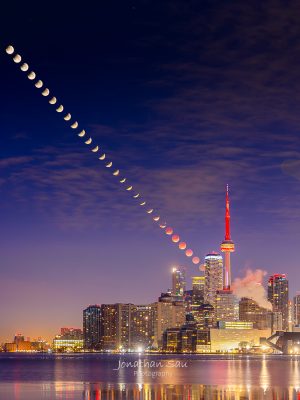
Blood Moon Setting, Toronto
Toronto awoke to a total lunar eclipse on March 3, 2026. This composite image captured the eclipse sequence unfolding behind the Toronto skyline, from the start of the partial eclipse at 4:50 am, till the eclipsed moon went behind the skyline at 6:14 am. Totality started at 6:04 am, just as the sky gradually brightened from the morning twilight. All the images in this sequence and the Toronto skyline were captured at 3-minute intervals from the same camera angle from Polson Pier.
A total lunar eclipse is also called a “blood moon”. The eclipsed moon is not totally dark – sunlight can reach the moon via refraction by Earth’s atmosphere. The reddish colour of the moon is due to the blue part of sunlight being scattered by Earth’s atmosphere, leaving primarily red and orange light reaching the moon – the exact same reason why the sun is orange during sunset.
-
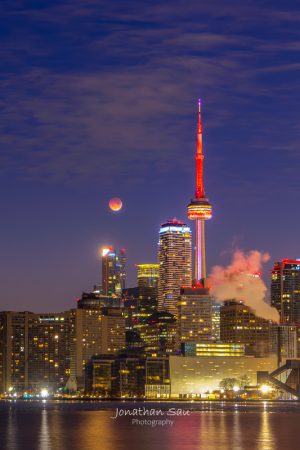
Blook Moon over Toronto, 2026
Toronto awoke to a total lunar eclipse on March 3, 2026. This image was captured from Polson Pier at 6:06 am, two minutes after the start of totality, just as the sky gradually brightened from the morning twilight.
A total lunar eclipse is also called a “blood moon”. The eclipsed moon is not totally dark – sunlight can reach the moon via refraction by Earth’s atmosphere. The reddish colour of the moon is due to the blue part of sunlight being scattered by Earth’s atmosphere, leaving primarily red and orange light reaching the moon – the exact same reason why the sun is orange during sunset.
-
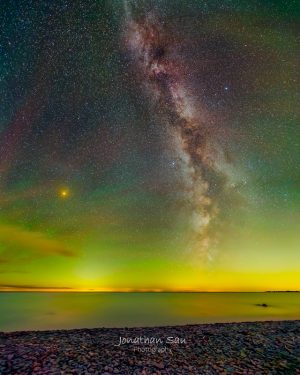
Full Moon Eclipsed, Milky Way Revealed
During full moon, the bright moonlight washes out most of the interesting features in the night sky. What happens if the moonlight is blocked out?
This image, taken just after midnight of August 28, 2026 during a deep partial lunar eclipse, answers the question. Even when 96.3% of the lunar surface was in Earth’s shadow, the moon, the bright orb on the left, is still the brightest object in the sky. However, with the moonlight greatly dimmed, the Milky Way is now clearly visible, while airglow painted the sky green and red, Cities across Lake Ontario (Rochester, Buffalo and Niagara Falls) gave the horizon its golden glow.
This image is a three-panel mosaic shot with my 14mm ultra-wide angle lens, covering from the horizon to the zenith and beyond.
-
Misty Dawn in Algonquin
Morning fog in Algonquin Provincial Park.
-
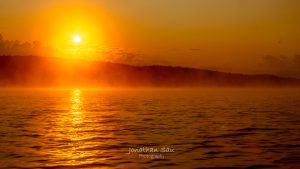
Sunrise, Lake of Two Rivers
Morning fog in Algonquin Provincial Park.
-
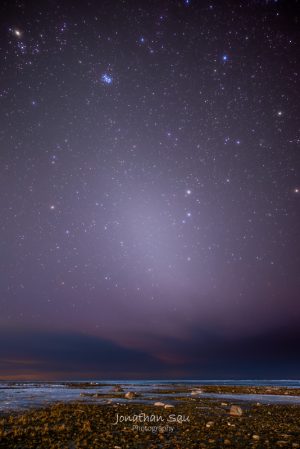
Zodiacal Light over Icy Lake Huron
Zodiacal light, captured in March by the Lake Huron shore, when spring is around the corner and ice on the lake starts to retreat. The zodiacal light is the patch of light extending from the centre of the image to the top left, passing through Taurus, Aries and Pisces, three of the constellations on the zodiac.
Zodiacal light is sunlight scattered by interplanetary dust orbiting the sun. Imagine the ecliptic plane on which Earth (and to a good approximation, most planets) orbits the sun. On this same plane is the dust cloud, from Earth’s orbit to just beyond Mars, that gives us zodiacal light. There are various theories as to the origin of this dust, from debris left behind by comets, to dust whipped up from Mars.
At mid-latitudes, zodiacal light is best observed around the spring equinox looking west just after the end of dusk, or around the fall equinox looking east just before the start of dawn.
-
In the Shadow of the Moon
A composite of the total solar eclipse on April 8, 2024, photographed at Lake Magog, Quebec, Canada. This composite covers 3.5 hours duration in total, including the entirety of the eclipse, with individual solar images 5-6 minutes apart. All elements of the image were taken at 28 mm focal length from the same camera position, therefore reflecting their true relative sizes and positions.
During a total solar eclipse, the sky turns dark. Near the horizon, however, one can see the distant atmosphere that is outside the shadow of the moon and is lit by the sun, creating the twilight effect much like during sunrise and sunset, except that this happens in the middle of a sunny day!
-
Annular Solar Eclipse, 2023
This composite image of the October 14, 2023 annular solar eclipse was captured from Kodachrome Basin State Park in Utah. The landscape was taken just before the rising sun cleared the hoodoo, and then 58 exposures of the sun (captured with solar filter), taken 4 minutes apart, covering the entire duration of the eclipse, were added. As with all my astro landscape images, all exposures were taken from the same camera position, using the same lens, therefore accurately reflecting the actual unfolding scene. An annular solar eclipse happens when the moon goes between the sun and Earth while near its apogee (furthest point from Earth in its elliptical orbit), and therefore does not complete cover the sun. While not as spectacular as a total solar eclipse, the “ring of fire” is still a sight to behold.
-
Partial Solar Eclipse, 2021
A partial solar eclipse during sunrise on June 10, 2021.
-
Total Lunar Eclipse in Toronto, 2019
This image captured the progression of the total lunar eclipse on January 20-21, 2019. The winter full moon was high in the sky and that made it hard to compose an eclipse shot with an interesting foreground … unless the foreground is pretty tall, like the CN Tower! With lunar trajectory information available online, Google Maps, and a bit of calculation using high school trigonometry, Simcoe Park on Front Street, Toronto turned out to be the location where the eclipsed moon could be seen passing exactly behind the tip of the CN Tower. The entire sequence lasted about 3 hours with images taken approximately 5 minutes apart, and was taken on a frigid night when the temperature plunged to -22°C.
-
Ocean Dynamics
I spent half a morning photographing the surf from the Pacific Ocean. Every image was different and there wasn’t a dull moment. I loved all the action, how the stiff breeze sheared off the top of the breaking waves, and how the water turned into streaks of blue.
A black-and-white version of this image was selected to represent Canada in the 2024 Four Nations Competition, in which Team Canada won first place.
-
Ocean Spirit
I spent half a morning photographing the surf from the Pacific Ocean. Every image was different and there wasn’t a dull moment. I loved all the action, how the stiff breeze sheared off the top of the breaking waves, and how the water turned into streaks of blue.
-
Ferocious Lake Erie
Gale force wind sent Lake Erie churning at Port Stanley, Ontario. Winter storms are common occurrence in the Great Lakes, with wind gust frequently reaching 90-100 km/h.
-
Unrelenting Waves
Lake Superior, churning from the steady wind on this September day. I wanted to capture the unrelenting waves pounding on the shoreline, sculpting the landscape, as they have been for millennia. A black-and-white long exposure suits the mood.
This image was accepted at the International Salon New York 2021.