Lunar-eclipse
-
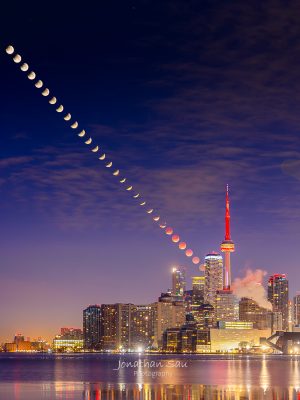
Blood Moon Setting, Toronto
Toronto awoke to a total lunar eclipse on March 3, 2026. This composite image captured the eclipse sequence unfolding behind the Toronto skyline, from the start of the partial eclipse at 4:50 am, till the eclipsed moon went behind the skyline at 6:14 am. Totality started at 6:04 am, just as the sky gradually brightened from the morning twilight. All the images in this sequence and the Toronto skyline were captured at 3-minute intervals from the same camera angle from Polson Pier.
A total lunar eclipse is also called a “blood moon”. The eclipsed moon is not totally dark – sunlight can reach the moon via refraction by Earth’s atmosphere. The reddish colour of the moon is due to the blue part of sunlight being scattered by Earth’s atmosphere, leaving primarily red and orange light reaching the moon – the exact same reason why the sun is orange during sunset.
-
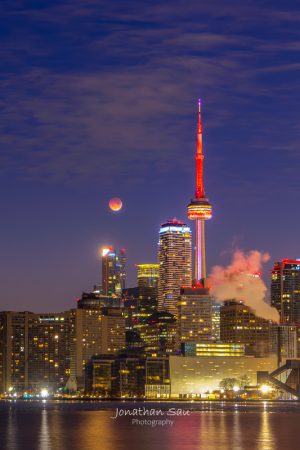
Blook Moon over Toronto, 2026
Toronto awoke to a total lunar eclipse on March 3, 2026. This image was captured from Polson Pier at 6:06 am, two minutes after the start of totality, just as the sky gradually brightened from the morning twilight.
A total lunar eclipse is also called a “blood moon”. The eclipsed moon is not totally dark – sunlight can reach the moon via refraction by Earth’s atmosphere. The reddish colour of the moon is due to the blue part of sunlight being scattered by Earth’s atmosphere, leaving primarily red and orange light reaching the moon – the exact same reason why the sun is orange during sunset.
-
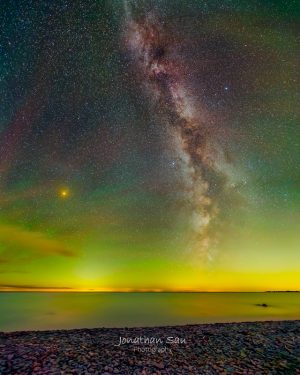
Full Moon Eclipsed, Milky Way Revealed
During full moon, the bright moonlight washes out most of the interesting features in the night sky. What happens if the moonlight is blocked out?
This image, taken just after midnight of August 28, 2026 during a deep partial lunar eclipse, answers the question. Even when 96.3% of the lunar surface was in Earth’s shadow, the moon, the bright orb on the left, is still the brightest object in the sky. However, with the moonlight greatly dimmed, the Milky Way is now clearly visible, while airglow painted the sky green and red, Cities across Lake Ontario (Rochester, Buffalo and Niagara Falls) gave the horizon its golden glow.
This image is a three-panel mosaic shot with my 14mm ultra-wide angle lens, covering from the horizon to the zenith and beyond.
-
Blood Moon, 2022
This image of the totally-eclipsed moon was taken in the pre-dawn hours of November 8, 2022. Unlike a total solar eclipse that is viewable only along a narrow path of totality, a total lunar eclipse can be seen from the entire night side of the Earth.
A total lunar eclipse is also called a “blood moon”. The eclipsed moon is not totally dark – sunlight can reach the moon via refraction by Earth’s atmosphere. The reddish colour of the moon is due to the blue part of sunlight being scattered by Earth’s atmosphere, leaving primarily red and orange light reaching the moon – the exact same reason why the sun is orange during sunset.
-
Total Lunar Eclipse in Toronto, 2019
This image captured the progression of the total lunar eclipse on January 20-21, 2019. The winter full moon was high in the sky and that made it hard to compose an eclipse shot with an interesting foreground … unless the foreground is pretty tall, like the CN Tower! With lunar trajectory information available online, Google Maps, and a bit of calculation using high school trigonometry, Simcoe Park on Front Street, Toronto turned out to be the location where the eclipsed moon could be seen passing exactly behind the tip of the CN Tower. The entire sequence lasted about 3 hours with images taken approximately 5 minutes apart, and was taken on a frigid night when the temperature plunged to -22°C.